Land acknowledgements honor a place’s Indi genous people – past and present – and recognize the history that brought u s to where we are today. The practice of incorporating land acknowledgement s into presentations and programs has become increasingly popular and gener ated debate about their effectiveness.
The Office of Diversity\, Equi ty and Inclusion in partnership with the Department of Neuroscience are hos ting Dr. Pamela Begay\, Ph.D.\, the Director of the Buder Center of Indigen ous Studies and Eric Pinto\, MSW Buder Center Community Projects Coordinat or at Washington University to share the purpose and importance of land ack nowledgments and considerations for incorporating the practice with integri ty. The session will include discussion about what individuals and groups c an do beyond land acknowledgment to ensure the effectiveness of the practic e and deepen commitment to inclusion for Indigenous people in our community .
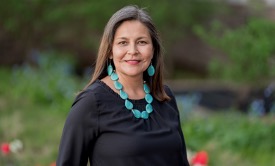
Pamela L. Begay's work focuses on American Indian tribes\ , and her research interests include cultural identity and issues surroundi ng Native women. Her long-term goal is to teach and mentor the next generat ion of social workers and maintain her private clinical practice.
Sin ce joining the Brown School in 2022\, Begay chairs the American Indian/Alas ka Native Concentration and serves as a faculty associate for the Buder Cen ter for American Indian Studies. She has taught undergraduate and graduate- level social work courses and maintains a private practice focusing on trea ting trauma while infusing psychodynamic therapy.
She is the senior e ditor for the Journal of Indigenous Research and an editorial board member of the Clinical Social Work Journal.

Eric Pinto (Mississippi Ban d of Choctaw Indians\, Zuni)\, MSW\, earned his BS in Health Management fro m Southeast Missouri State University in 2010 and is a 2020 Buder Scholar a lumnus from the Brown School with a concentration in American Indian/Alaska n Native. Prior to receiving his MSW\, Eric was a Certified Strength and Co nditioning Specialist for nine years at two Gold’s Gym locations in the St. Louis area. During his time at the Brown School\, he gained experience in program development\, assessment\, and supporting the St. Louis Zoo in deve loping and sustaining long-term relationships with tribal communities. Afte r graduating in the summer of 2020\, Eric began working for the Buder Cente r as Project Coordinator where he oversaw development and production of the Digital Indigenous Storytelling Project. Currently\, Eric is the Coordinat or of Community Projects where he provides knowledge\, opportunities\, conn ection and support to the local Indigenous community\, the larger St. Louis community\, and the Buder Scholars.
[formid able id="378"]
Individuals with di sabilities are encouraged to attend all Washington University School of Med icine sponsored events. If you are a person with a disability who requires a reasonable accommodation in order to participate in this event\, at leas t one week before the event\, please contact the Washington University Scho ol of Medicine Office of Diversity\, Equity and Inclusion in advance at 314 -273-2809 or MedDEI@wust l.edu.
CATEGORIES:Perspectives Series LOCATION:Zoom (Virtual) GEO:38.635102;-90.262792 ORGANIZER;CN="Tonna":MAILTO:tonna.wilson@wustl.edu URL;VALUE=URI:https://diversity.med.wustl.edu/events/calendar/the-importanc e-of-indigenous-land-acknowledgements-and-what-comes-next/ END:VEVENT BEGIN:VTIMEZONE TZID:America/Chicago BEGIN:STANDARD TZOFFSETFROM:-0500 TZOFFSETTO:-0600 DTSTART:20221106T070000 TZNAME:CST END:STANDARD END:VTIMEZONE END:VCALENDAR